I’m trying to get my head round basing in Volley & Bayonet and would welcome any thoughts or advice.
I’m not looking to accurately depict each different type of brigade from each nationality. That way lies madness! I’m looking to make an semi-informed generalisation that could represent a brigade.
From reading around I’ve come up the following, based on both ideal / fudged (for easy arithmetic’s sake) values and possible numbers in the field.
NB I’m going with massed infantry / cavalry stands.
800 men in a battalion, and 3 battalions in a brigade, making 2400.
150 horse in a squadron and, 4 squadrons in a regiment, and 4 regiments in a brigade, making 2400.
Does that sound reasonable in a general sort of way?
In order to make it achievable, I’ve opted for a 1:200 figure man ratio, so that would make both infantry and cavalry brigades have 12 figures.
If infantry skirmishers represent about a battalion’s worth of men, they would therefore have 4 figures (2400/3/200) and cavalry skirmishers would have 3 figures (2400/4/200). Though if you considered that some infantry brigades have 4 strength points and a skirmisher stand has 1 strength point, then you could consider that it too has 3 figures (12/4). 3 skirmishers on a skirmish base might be more aesthetically pleasing (and less crammed) than 4.
NB I’m going to be using 6mm figures and hoping to base them on half-sized bases, and use half measurements as play space is at a premium.
I’m a fan of Bob Cordery’s The Portable Wargame. It provides a way to play conclusive and dramatic battles without getting bogged down in byzantine rules. The game suits sparring tabletop generals and the solo hobbyist. However in my efforts to play it remotely (eg on VASSAL), there is one particular aspect that I’ve been mulling over.
When a unit is hit, the defending unit rolls to see whether they must either:
take the damage
choose between taking the damage or retreating
nb Higher quality troops are more likely to have the choice of holding or retreating.
I like this rule as it gives the non-active player an opportunity to make tactical decisions during the active player’s turn. However for games that are played remotely, this is a potential snagging point if the players are not present at the same time. In such asynchronous situations, the active player may have to wait on the non-active player communicating their wishes before the active player’s turn can be completed. This isn’t arduous but it does slow the flow of each turn that involves combat. Which in a wargame, can be numerous.
So here are some thoughts on possible guidelines (which could be adopted if both sides are in agreement) to help determine what a defending unit will do, when given a choice:
A defending unit will hold a strategic position if there’s a chance that reinforcements will arrive before all is lost.
A defending unit will retreat from a strategic position, if holding it would mean that the unit is lost.
If not in a strategic position, a defending unit will retreat towards a stronger position, or towards friendly lines (whichever is closer).
If there is any doubt as to which direction a retreating unit should move, it should be directly away from the attacking unit and not closer towards any other enemy unit.
You would of course have to agree before the battle, which locations were strategic positions. But hopefully this should be quite apparent whilst surveying the battlefield. Towns, bridges, hills, fieldworks and fortifications would be likely candidates. Woods overlooking open ground could be advantageous positions too depending on the map.
Hopefully these guidelines will be of use to anyone wanting to streamline their remote play, or indeed the solo gamer who sees merit in reducing the bias that they may have whilst playing “the enemy”.

Since I’ve been such a good boy this year, Santa delivered some prezzies a little early. What a good sport!
My old pal Ian Taylor of the East Neuk Irregulars was a Spanish Civil War aficionado. As a result the SCW has been on my mind of late as a potential project. Thankfully Bob Cordery has recently re-released Arriba Espana which now includes rules for playing the SCW with his Portable Wargame system. I’m particularly taken by the huge range of warring factions in the SCW but I admit I’m a complete greenhorn when it comes to who is who. I’d seen Bob’s La Ultima Cruzada recommended as a top-notch SCW sourcebook, so thought it would be a timely addition to my reference library.
And why get two, when you can have four? I must admit Bob’s The Balkan League came at me from left field. But in it he presents rules for matrix games, which is an area I haven’t explored yet, so will be interesting to see what’s what where that’s concerned. And Portable Naps? Well, in for a penny, in for a pound!
I’ve certainly got plenty to tuck in to this Christmas. May Santa be equally as kind to you. All the very festive best!
I recently finished reading Donald Featherstone’s Advanced War Games (1969). I think it’s only fair to say that it’s a bit of a hotchpotch of wargaming ideas from the early years of the modern hobby. Having said that, I’m glad I’ve read it. Not only has it has helped me appreciate the pioneering work that Donald and his contemporaries contributed to the hobby, but it’s been a palate cleanser of sorts. When you strip things down to their nuts and bolts and see things with fresh eyes, it can help you build anew.
Donald presents extensive morale rules – 19 pages in all! There are tailored morale tables for Ancients, Medieval, 18th century, 19th century, colonial and American Civil War, each detailing the various factors which could be applicable during that period. However it was some of the possible outcomes that I was particularly taken by; troops retreating in good order and those retreating in disarray. These feature in military history time and time again, yet there seemed to be no rule to help actualize this in one of my current wargames of choice, The Portable Wargame by Bob Cordery.
In The Portable Wargame, retreating is one possible outcome of a unit being under fire – the other being the degradation of their Strength Point value. But when a unit retreats, the direction that the unit is facing seems to be left up to the player in charge of that unit. Given the choice I’m sure no-one would want to have their rear facing the enemy when there’s a chance that they could follow up, but history tells us that this could and did happen.
So here is a simple houserule for The Portable Wargame to determine the direction that a retreating unit is facing, when the quality, condition and situation of the troops are considered, inspired by the distilled ideas of Donald Featherstone.
Portable Wargame: Retreating
When a unit retreats, roll 1d6 to see if it’s conducted in good order.
If the retreating unit makes its target number, then it retreats in good order and does so facing the enemy.
If the retreating unit fails to make its target number, then the unit is routing and faces away from the enemy.
Target numbers:
Elite: 3+
Average: 4+
Poor: 5+
Modifiers to the dice roll:
Friendly Commander with the retreating unit: +1*
For each friendly unit in good order that’s on the flanks of the retreating unit (within 2 hexs of the unit’s initial location): +1
If the retreating unit has already lost half or more of its SP: -1
If retreating from artillery fire: -1
* If using Commander ratings as described on p39 of The Portable Wargame, then you could use the following:
After a week of work on my VASSAL module to play the Franco-Prussian War using The Portable Wargame, I’m nearly at a suitable place to catch my breath. I probably could’ve finished it by now but I succumbed to feature creep and implemented a battle start time generator and day/time turn tracker inspired by Donald Featherstone’s “War Games“.
I’ve also created some Day / Twilight (as shown above) / Night visual effects so that the turn time could be used to affect play. And finally I’ve made it easy to deploy Fieldworks + Fortifications (also shown above).
If I behave myself and don’t add any more bells & whistles, I should be able to finish version 1.0 this week and get it play-tested with a live opponent.
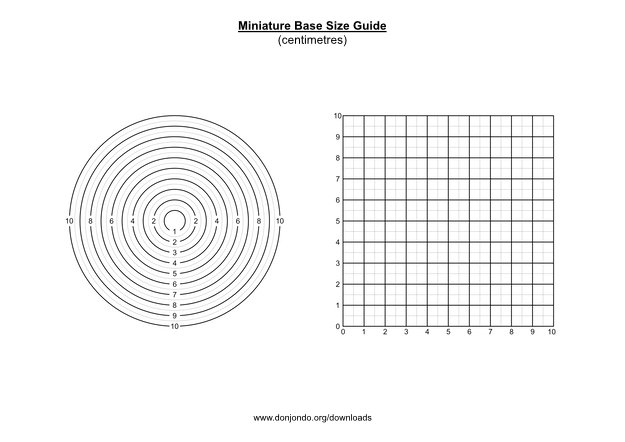
When planning on how best to base certain miniatures (especially the unconventional kind) I found myself wanting a guide to help me eyeball things. Given that I can’t help myself but embark on another project to fill my day, I created a miniature base size guide for round and oblong bases.
Pictured above are examples of it in use. On the left is a 54mm undead warrior from Tehnolog and on the right are four 20mm Afghans from Newline Designs.
It was particularly useful when trying to figure out how to base my various trees, before I had a stockpile of MDF bases in various sizes from Warbases to try them out with. Pictured above is the resulting fruits of my labours. Two trees from Games Workshop on the left on 60mm and 40mm, and a random model railway bottle-cleaner style tree on a 35mm base. When it comes to trees, I think it looks best when the base isn’t quite as wide as tree but wide enough to stop it from toppling easily. (Yes I know they would look even better if I finished basing them… they’re in the queue).
Click the image to view the PDF. You can then Download it for your use.
Anyhoo… pictured above is the guide that I created with Affinity Designer (which, if you’re in to such things, is an inexpensive vector art program comparable to Adobe Illustrator). You’re welcome to use the guide for your own personal purposes.
NB YOU WILL NEED TO PRINT IT ‘ACTUAL SIZE’, NOT ‘SHRINK TO FIT’ OR ELSE IT WON’T BE THE CORRECT SCALE!
For ease of future reference, I’ve also added it to the Downloads page. Have a look… there might be something else that you find handy.
You may have noticed that I’m a big fan of Crossfire, a WWII company-level wargame. If you’re interested in finding out why, then I’d recommend watching the following Crossfire intro videos courtesy of Lindybeige and Paul Ward (aka Matakishi’s Tea House). They should give you a good feel for some of the unique aspects to the game. I’ve compiled them into a playlist for your convenience.
Paul suggests some simple alternative houserules for close combat and tanks, which are worth contemplating if you aren’t keen on those sections of the rules-as-written. However I’d always recommend playing a game straight at first until you’ve got a handle on the experience that it’s trying to emulate.
Crossfire recommends base sizes for figures of 15-20mm (or 25mm). They are 1 1/4″ square (that is ~32mm) or 1 1/4″ x 5/8″ (or ~32mm x ~16mm).
Personally I find the recommendations a bit on the small side for 1/72 scale (20mm) miniatures, especially those figures that are already individually based and need mounting on a group stand. So over the years I’ve toyed around with various options and I’ve settled on the following:
Rifle / SMG Squad: 40x40mm round-cornered base with 3 figures
HMG / On-table Mortar: 40x40mm square base with 2 figures + weapon
PC: 1p base in a single figure tray
CC: 40mm circular base with 2 figures
BC: 40mm circular base with 3 figures
FO / AT: 2p base with 1 figure
Sniper: 2p or 20x40mm round-cornered or pill base as appropriate
Here are my thoughts on the above-mentioned units and base types…
Rifle / SMG Squads and HMG / On-table Mortars
I used to use squares for my rifle squads but now prefer the rounded-edged bases for those troops as they don’t need to be regimented like Napoleonic forces. However I still use straight-edged bases for HMGs and on-table Mortars as the base is useful for eyeballing their 90° arc of fire.
Commanders
Platoon Commanders
I really didn’t like the recommended size for Platoon Commanders. I know it was useful to have one dimension equal to the standard squad base-width, however there was a lot of excess base and I didn’t find it very aesthetically pleasing. It also seemed to be a rather unique base size for a leader, which would be a bit jarring when used with other game systems.
Left to my own devices, I probably would’ve based my PCs on 2p bases, however I inherited some figures based on 1p bases. To help distinguish them from the rank and file, my solution was to mount the leaders on a single figure tray. This also allowed me to colour code the single figure trays to highlight the platoon commander’s assistance modifier (gold = +2, silver = +1, copper / bronze = 0) and hot-swop them between games whenever necessary. Given that it’s possible to have lots of PCs on the table with different modifiers, this is pretty handy!
I could be wrong but I don’t think there are any PCs that have a modifier of 0, but there are French, Italian, Russian and US organisations that have varying PC modifiers depending on the context (see table below). So the copper / bronze tray would signify that.
Organisations
Rallying
Close Combat
French leg & motorized infantry and dismounted dragoons
+1
0
Italian leg & motorized infantry
+1
0
Russians
0
+1
United States leg & armoured infantry
+1
0
Company and Battalion Commanders
As CC and BC stands don’t fire, I thought it’s not that important to have squarish bases as facing isn’t an issue. Round bases are the classic shape for commanders on the tabletop so why break with tradition? However as they can both engage in close combat I thought it best to use a similar base size to the Rifle / SMG Squads.
Anti-tank infantry markers
Rather than create additional rifle squad bases featuring anti-tank weapons (eg Panzerfaust, Panzershreck, Bazooka), I’ve settled on using an individually based AT figure, which is essentially a token, to place beside the squad in question to designate their upgraded equipment. You just need to remember that the AT figure is just a token, and AT fire is from the centre of the squad base not the AT figure themselves. Usually I’d use a 2p base for AT figures but in the case of prone PIATs or Anti-Tank Rifles I may base them as a regular Rifle squad should the need arise.
Conclusion
I guess it was a blessing and a curse that when I started playing Crossfire there weren’t any local players whose basing style I needed to mirror. Anyhoo, after much play and mulling over, this is what works for me. Maybe it’ll help you figure out what’s good for you? If you’re looking for a base supplier, then why not try Warbases. That’s where I got my MDF mountain.