
Tag Archives: 19th century

Volley & Bayonet: basing brigades

I’m trying to get my head round basing in Volley & Bayonet and would welcome any thoughts or advice.

I’m not looking to accurately depict each different type of brigade from each nationality. That way lies madness! I’m looking to make an semi-informed generalisation that could represent a brigade.

From reading around I’ve come up the following, based on both ideal / fudged (for easy arithmetic’s sake) values and possible numbers in the field.

NB I’m going with massed infantry / cavalry stands.

  • 800 men in a battalion, and 3 battalions in a brigade, making 2400.
  • 150 horse in a squadron and, 4 squadrons in a regiment, and 4 regiments in a brigade, making 2400.

Does that sound reasonable in a general sort of way?

In order to make it achievable, I’ve opted for a 1:200 figure man ratio, so that would make both infantry and cavalry brigades have 12 figures.

If infantry skirmishers represent about a battalion’s worth of men, they would therefore have 4 figures (2400/3/200) and cavalry skirmishers would have 3 figures (2400/4/200). Though if you considered that some infantry brigades have 4 strength points and a skirmisher stand has 1 strength point, then you could consider that it too has 3 figures (12/4). 3 skirmishers on a skirmish base might be more aesthetically pleasing (and less crammed) than 4.

NB I’m going to be using 6mm figures and hoping to base them on half-sized bases, and use half measurements as play space is at a premium.

TMWWBK: The Battle of Saragarhi

The latest edition of Wargames, Soldiers & Strategy features a scenario for The Men Who Would Be Kings on the North-West Frontier.

It is ‘The Battle of Saragarhi, 12 September 1897 – No fear of death’ by Eoghan Kelly.

https://www.karwansaraypublishers.com/wss-issue-117.html

Saragarhi is a famous last-stand of the Tirah campaign, when 21 Sikhs defended an isolated outpost against thousands of Afghan tribesmen.

https://en.wikipedia.org/wiki/Battle_of_Saragarhi

The Franco-Prussian War week-by-week

The Franco-Prussian War started 151 years ago this month. To commemorate that, the Real Time History YouTube channel just has launched its week-by-week series on the war.

They’ve released a few videos which help set the scene for the upcoming war, and have now started on the weekly videos.

If you’ve ever wondered what the Franco-Prussian War was all about, now is your chance!

https://www.youtube.com/channel/UCB1eDEd1AYG3YrRIJSZzMOQ/playlists

The Franco-Prussian War by Michael Howard

Well lookee here! A new edition of Michael Howard’s “The Franco-Prussian War” has just been published. I’d been holding off on buying the previous edition because it was around £25. But at over 500 pages, that’s probably not unwarranted. So I was pleasantly surprised to see that not only had a new edition been released but also that it was a bit less of an outlay.

For those of you who aren’t aware of this tome, here’s the publisher’s blurb…

In 1870 the German Chancellor Otto von Bismarck ordered the Prussian Army to invade France, inciting one of the most dramatic conflicts in European history. It transformed not only the states-system of the European continent but the whole climate of European moral and political thought. The overwhelming triumph of German military might, evoking general admiration and imitation, introduced an era of power politics, which was to reach its disastrous climax in 1914.

Michael Howard’s The Franco-Prussian War is widely acclaimed as a classic and the definitive history of one of the most dramatic and decisive conflicts in the history of Europe. Evoking a palpable sense of the struggle and the high stakes of the war, Howard analyses the tactics, political dynamics, morale and actions that determined the course of the conflict. He also describes the crucial role played by key figures in the war, including Bismarck, the Prussian military commander Helmuth Von Moltke, and the French generals MacMahon, Chanzy and Trochu. He also sheds fascinating light on how difficult it was to bring the war to an end, with extremists in both France and Prussia pushing to prolong the conflict.

A tour de force of both European and military history, The Franco-Prussian War is a superb account of this dramatic and hugely important conflict, ideal for the student, historian and general reader alike.

This Routledge Classics edition includes a new Foreword by Bertrand Taithe.

I’m delighted to say that mine’s is in the post!

My 1st 10mm Franco-Prussian War miniatures

From L-R: French Infantry, French Command (3 figures), Turco, Zouave, Jäger

I took a wild punt on a job lot of Franco-Prussian figures from Chariot Miniatures the other day. I wasn’t really sure what I’d be getting, but I thought it might be a good way to get started with the FPW, as regardless of what I got, it would be something that I could build from. I mean, I’m going to need lots of everything really. Though I’m not going to rush in to all the Prussian allied states *just* yet!

After a bit of internet sleuthing it seems that Chariot Miniatures are no longer trading and their FPW range may have been acquired by Magister Militum. Certainly some of the sculpts and catalogue numbers are similar. So that’ll be handy if I want to top up any of the units in the same style. Though it does look like some of the packs aren’t available on the MM website. I assume they’ve combined certain packs eg the command and the line infantry. Also the Chariot packs have 12 infantry and 6 cavalry, as opposed to Magister’s 30 infantry and 12 cavalry.

From L-R: French Hussar, French Cuirassier

There is a Chariot Miniatures website still partially accessible courtesy of the Internet Archive, however their Franco-Prussian War page is sadly absent. So for the benefit of anyone who is trying to find out any information about their FPW range here’s as much info as I’ve managed to work out.

  • SFE1: French infantry
  • SFE2: French infantry command (4 officers, 4 standard bearers and 4 drummers)
  • SFE3: French Turcos
  • SFE5: French Zouaves (with turbans)
  • SFE10: French Hussars
  • SFE12: French Cuirassiers
  • PUG3: Prussian Jägers

Anyhoo, these are the first 10mm figures that I’ve seen close at hand, and I must say I’m amazed at the detail in such small miniatures. They’re quite remarkable! I’m looking forward to picking up some Pendraken 10mm next to see how they compare.

Paper soldiers galore!

With thoughts of playing a greater variety of wargames but with less investment in figures, time and storage space, I’ve come round to the notion of using paper miniatures. At the very least, they allow you to try out a game relatively quickly after reading it, to help you decide whether or not you want to pursue a project before it even begins.

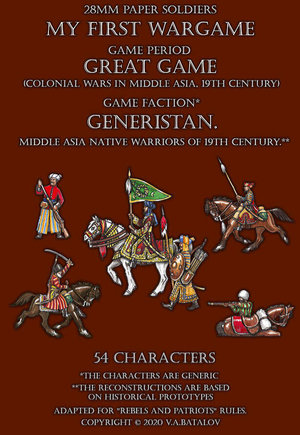
I was rather delighted to see that an artist called Vyacheslav Batalov has released some magnificent paper miniatures for 19th century Central Asia on Wargame Vault. I have the two sets pictured above and they are beautifully illustrated. Vyacheslav has since released Afghan Tribesmen, Afghan Regulars and two sets of Indian Army figures – the first of which includes Gurkhas (set 1 and set 2).

Alternatively you can get hordes of paper miniatures for free from the Junior General website.

Franco-Prussian War resources update

Whilst trawling through old issues of Wargames Illustrated, I stumbled across a set of wargames rules for the Franco-Prussian and the Russo-Turkish wars. The memorably-named Schlachtenbummler (it translates as “away supporter / fan”), by Richard Brooks, clocks in at only 4 pages long, and can be found in Wargames Illustrated #5.

I’ve updated the earlier post on Franco-Prussian War resources, to include this omission. That post also includes details of how to get hold of WI back issues.